[ad_1]
The $45 million Google Netanyahu propaganda deal has sparked global outrage, exposing how tech giants are shaping narratives in the Israel-Gaza conflict.
Google in the Crosshairs: The $45 Million Netanyahu Propaganda Deal
A Google Netanyahu propaganda deal worth $45 million, signed in late June 2025, has thrust the tech giant into the center of a global controversy over digital propaganda, media manipulation, and the weaponization of information in the Israel-Gaza conflict. According to investigative outlet Drop Site News, Google was designated a “key entity” in the Israeli government’s public relations strategy, tasked with amplifying official narratives that downplay the humanitarian catastrophe in Gaza.
This contract marks one of the most expensive and systematic uses of digital advertising by a state to influence global public opinion during an active war.
The campaign launched shortly after Israel imposed a total blockade on food, medicine, fuel, and humanitarian supplies to Gaza on March 2, 2025—a move that the United Nations and human rights groups have described as a collective punishment of civilians. At the time, Israeli lawmakers debated the potential “reputational damage” of the blockade, signaling a coordinated effort to control the narrative before the world.
Google’s role has been pivotal. Through its advertising platforms—YouTube, Display & Video 360, and Google Ads—the Israeli government has pushed state-produced content to millions of users worldwide, often bypassing traditional media gatekeepers and leveraging algorithmic amplification.
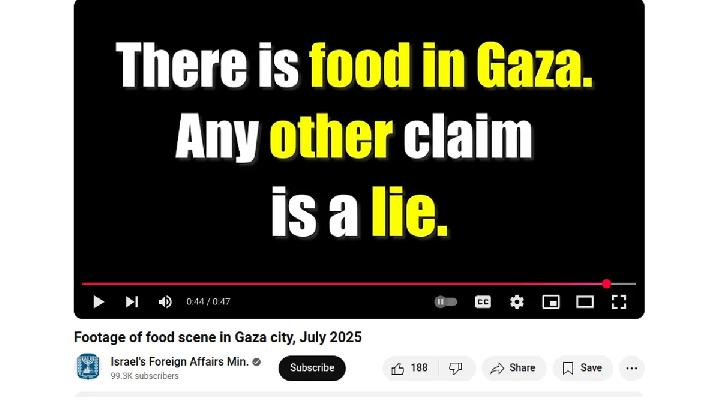
One particularly controversial video, published by Israel’s Ministry of Foreign Affairs, claims: “There is food in Gaza. Any other claim is a lie.” Despite overwhelming evidence to the contrary, the clip has garnered over 6 million views, largely due to paid promotion through Google’s ad network.
This form of state messaging, known in Hebrew as “hasbará”—literally “explanation,” but widely understood as government propaganda—is now being scaled through Silicon Valley’s most powerful digital tools.
Geopolitical Context: Digital Warfare in the Age of Tech Giants
The Google Netanyahu propaganda deal must be understood as part of a broader shift in modern warfare: the battle for narrative dominance. In an era where perception shapes policy, governments are increasingly turning to private tech corporations to wage information wars.
This is not just about public relations—it is asymmetric digital warfare, where algorithms, data, and advertising budgets are used as weapons.
Israel has long been a leader in digital influence operations. But the 2025 campaign represents a quantum leap in scale and sophistication, combining paid media, AI-driven targeting, and platform partnerships to shape global discourse.
The deal coincided with Operation Rising Lion, a 12-day conflict between Israel and Iran in June 2025 that resulted in over 1,000 Iranian civilian deaths, including women and children. During this period, Google’s platforms were used to justify Israeli strikes and discredit Iranian and Palestinian sources.
Meanwhile, platforms like X (formerly Twitter) received $3 million from Israel for similar campaigns, and Outbrain/Teads, a Franco-Israeli ad network, secured $2.1 million in government contracts. Together, these expenditures form a coordinated digital propaganda apparatus designed to control the global narrative.
Critics argue that by accepting these funds, U.S. tech companies are complicit in disinformation that obscures war crimes and humanitarian suffering. The fact that Google, a U.S.-based corporation, is enabling a foreign government to manipulate global audiences raises serious questions about corporate accountability, transparency, and neutrality.
Moreover, the deal underscores the erosion of journalistic independence, as state-funded content floods platforms without clear labeling or fact-checking. Unlike traditional media, digital platforms are not bound by editorial standards, allowing governments to bypass scrutiny and reach audiences directly.
YouTube and the Weaponization of Video Content
YouTube, owned by Google, has become a central battleground in the information war over Gaza. The platform’s algorithm favors engagement over accuracy, often promoting emotionally charged or controversial content—making it ideal for propaganda.
The viral video claiming “There is food in Gaza” is a case in point. It features a well-lit warehouse with stacked food packages, accompanied by a voiceover dismissing reports of famine as “lies spread by terrorists.” The footage is selective, omitting the reality on the ground.
According to the UN Office for the Coordination of Humanitarian Affairs (OCHA), Gaza is experiencing a full-scale famine, with 95% of the population facing acute food insecurity.
The Ministry of Health in Gaza reported that 367 people have died from hunger and malnutrition since October 2023, including 131 children. Doctors Without Borders (MSF) has described conditions as “apocalyptic,” with hospitals overwhelmed and families surviving on grass and animal feed.
Yet, Google’s ad tools have ensured that the Israeli government’s message reaches millions of viewers, often without context or counter-narratives. The use of targeted advertising allows the content to appear in search results, recommendations, and even on unrelated videos through pre-roll ads.
This raises ethical concerns about algorithmic bias and corporate complicity. While Google claims its ad policies prohibit “misleading content,” it makes exceptions for “government messaging,” effectively granting states a free pass to spread disinformation under the guise of official communication.
Silencing Dissent: Targeting Palestinian Voices
The Google Netanyahu propaganda deal is not only about promoting Israel’s narrative—it is also about discrediting and silencing Palestinian voices.
Organizations like the Heinrich Hayab Foundation, which documents human rights abuses in Palestine, have been systematically targeted in Israeli campaigns. Their reports on civilian casualties, forced displacement, and medical shortages are dismissed as “terrorist propaganda” in state-sponsored content.
Social media accounts of journalists, activists, and humanitarian workers in Gaza have faced shadow banning, demonetization, and suspension—often without explanation. Meanwhile, pro-Israel content is amplified through paid promotions and algorithmic favoritism.
Experts warn that this creates an information asymmetry where one side’s suffering is minimized, while the other’s is magnified. As one digital rights advocate stated: “When Google becomes the megaphone of a state at war, truth becomes the first casualty.”
Global Backlash and Calls for Accountability
The revelation of the Google Netanyahu propaganda deal has triggered international condemnation. Human rights organizations, digital ethics experts, and UN officials have called for greater regulation of tech companies involved in conflict zones.
🔗 Electronic Frontier Foundation – Digital Rights in Conflict Zones
European lawmakers have demanded that Google disclose all government contracts related to war zones and implement stricter content labeling for state-sponsored ads. In the U.S., members of Congress have questioned whether such deals violate foreign lobbying laws or constitute unauthorized military support.
Activists are also pushing for algorithmic transparency, demanding that platforms reveal how content is prioritized and who funds its promotion. The lack of oversight, they argue, allows governments to manipulate public opinion without accountability.
Moreover, the deal has reignited debates about Big Tech’s role in geopolitics. Once seen as neutral platforms, companies like Google, Meta, and X are now recognized as strategic actors with the power to shape wars, elections, and social movements.
Conclusion: Truth in the Age of Digital Propaganda
The Google Netanyahu propaganda deal is more than a business contract—it is a watershed moment in the evolution of information warfare. It reveals how democracy, truth, and human rights are increasingly vulnerable to manipulation by state-corporate alliances.
While Gaza starves, algorithms feed the world a sanitized version of reality. While children die from malnutrition, paid ads claim there is “plenty of food.” This is not just misinformation—it is moral obscenity.
As the world grapples with the consequences, one truth remains clear: the battle for Gaza is not only being fought on the ground, but in the digital sphere—and tech giants are no longer bystanders.
The international community must act. Regulation, transparency, and ethical accountability are no longer optional. They are essential to preserving the integrity of information in an age where truth is under siege.
Author: JMVR
Source: Agencia Anadolu – Drop
[ad_2]
Source link