

[ad_1]

- Introduction
- What is Product Management?
- Product Management Career Path
- Product Management Job Roles/Careers
- Product Management Salaries
- Key Skills Required to be a Product Manager
- Frequently Asked Questions
Did you know that there are more than 698,000 product managers on LinkedIn as of August 2020? (Source) The product management roles have almost quadrupled in the last 4-5 years. It has been in a boom amidst the pandemic as the world is getting digital in nearly every field. According to The Wall Street Journal, 7% of Harvard Business School graduates have taken up a job in product management.
Well, you might be wondering what the fuss is about? Let’s deep dive into product management and the career path of a project manager.
What is Product Management?
Product management is generally the role within an organization responsible for the successful execution of end-to-end product life cycle from preliminary research to launch and post-sales support.
The product manager is the one who executes all the product management principles. It is an interdisciplinary role, and hence the responsibilities might vary from one organization to another.
Product Management Career Path
The ideal job for any individual in product management would be that of a product manager. The product manager is someone who manages one or multiple products across the same or various departments.
E.g., Product Manager working on a UX (user experience) of an android application.
However, the responsibilities of a product manager will vary depending on the type of product, business goals and the organization.
The product manager is like the captain of the IPL team but not the owner who is majorly responsible for the franchise’s overall success (business/product). They conduct research, strategize, shape the vision considering the end-users and all stakeholders.
Now, let us dive into detail to know more about various product management job roles.
1. Assistant/Associate Product Manager (APM)
Assistant/Associate Product Managers generally report to Product Managers. Their responsibilities are similar to Product Managers but on a smaller scale. APM is typically an entry-level role and requires a willingness to adapt, change and learn depending on the consumer requirements. There are a lot of learning opportunities for young professionals in this role as they directly work with Product Manager’s and can learn from them on team management and decision making.
Few important responsibilities:
- Conducting market research
- Data analysis
- Coordinating with multiple stakeholders
- Working on developing new product strategies and roadmap
- Preparing project reports and tracking the project
- Working on UI/UX with the design/software team
2. Product Manager (PM)
Product Manager is generally a mid-level role, and prior experience in product management is mandatory in most cases. Here they own the product and might work across various departments/teams. In most organizations, PMs will be the go-to person for anything needed on the product. They will be working closely with sales, marketing, design and other teams. PMs will need to be aware of everything happening in the product space and know their competitors well.
Few important responsibilities:
- Defining product strategy and roadmap
- Developing core positioning and vision for the product
- Coordinating with multiple teams
- Performing product demos
- Managing teams and internal/external stakeholders
- Thorough understanding of competitors
3. Senior Product Manager (SPM)
Senior Product Managers generally coordinate with senior heads of different teams such as sales, marketing, design, and others. They work closely with a leadership role and the clientele. They are responsible for overall team management, including product managers, engineering managers, analysts, associate product managers, and the entire product team. SPMs are also responsible for budgeting and promotion of the product. This role generally requires at least five years of experience in the product management space.
Few important responsibilities:
- Developing product strategy and roadmap
- Developing a business strategy and managing budgets
- Building robust processes for an effective end-to-end product lifecycle
- Coordinating with senior heads of various teams
- Managing internal/external stakeholders
- Thorough understanding of competitors
- Managing a large team
- Analyzing and reporting big data
- Handling recruitment
4. Group Product Manager(GPM)
Group Product Managers are product leaders who have more interactions with executives. They need to stay constantly updated with new trends and things happening in the market related to the product space. They are problem solvers and are known for anticipating, identifying and managing risks. Negotiating with external stakeholders for various collaborations will be one of their key responsibilities. They will have to oversee the entire team from junior level to senior level and manage conflicts as they arise (if any).
Few important responsibilities:
- Developing a business strategy and managing budgets
- Build robust processes for an effective end-to-end product lifecycle
- Coordinating with senior heads of various teams
- Negotiating with external stakeholders
- Risk analysis and mitigation
- Managing a large team
- Handling recruitment
5. Director – Product Management
The Director of Product is a leadership role generally responsible for overall product planning, and execution will require less hands-on involvement in indirect product management. The part involves making critical decisions around product strategy, vision and marketing/outreach. They collaborate with directors of other departments such as manufacturing, operations, sales, marketing and finance to ensure everything is in place.
Few important responsibilities:
- Developing a business strategy and managing budgets
- Coordinating with senior directors and leaders of various teams
- Negotiating deals and collaborations
- Risk analysis and mitigation
- Build scalable business via product marketing and outreach
- Stay on top of consumer trends and market demands
6. VP – Product Management
The Vice President of Product Management is also a leadership role that focuses on managing teams and product lines. The hands-on involvement decreases with Product Managers working to build teams, optimizing processes and staying up-to-date on what is happening in the product space. They are generally the company’s face in media, events and conferences and play a key role in strategic decisions. Acting as a bridge between the product team and CXOs plays a crucial role in the business.
Few important responsibilities:
- Owning product vision and route map
- Coordinating with C-suite level leaders and product team
- Building scalable business via product marketing and outreach
- Staying on top of consumer trends and market demands
- Interacting/meeting with consumers
- Identifying and building partnerships
7. Chief Product Officer (CPO)
CPO is a C-level executive in charge of the big picture product strategy and plays a significant role in long-term goal setting. This role is typically in large organizations such as MNCs and Fortune 500 companies. CPO’s responsibilities begin in the product research and extend beyond the product’s release. The CPO generally reports to the CEO and closely work with all critical C-level stakeholders.
Few important responsibilities:
- Responsible for long-term vision and goal setting
- Coordinating with C-suite level leaders and product team
- Product growth and Marketing
- Building a structured product organization
- Interacting/meeting with consumers
- Identifying and building partnerships
- Interviewing and recruiting team members
- Managing budgets, revenue and profit share
Product Management Salaries
After reading all this, you would be interested in knowing how much do product managers earn. Here is an overview of salaries of various product management roles in India and USA:
| Job Role/Careers | Salary in USA in USD | Salary in India in INR |
| Assistant/Associate Product Manager | 40,000 – 88,800 | 5,00,000 – 20,00,000 |
| Product Manager | 66,500 – 1,53,000 | 5,00,000 – 27,00,000 |
| Senior Product Manager | 1,00,000 – 1,80,000 | 10,00,000 – 40,00,000 |
| Group Product Manager | 1,27,000 – 2,45,000 | 15,00,000 – 45,00,000 |
| Director – Product Management | 1,15,000 – 2,20,000 | 30,00,000 – 77,00,000 |
| VP – Product Management | 92,900 – 2,11,000 | 30,00,000 – 1,00,00,000 |
| Chief Product Officer | 1,02,000 – 3,00,000 | 30,00,000 – 1,00,00,000 |
Key Skills Required to be a Product Manager
Product Managers come from diverse backgrounds ranging from Engineering to Sales and marketing. Different skill sets are required, but one can build on their strengths and improve in other areas. The skillsets might vary depending on the role and the product. Here are few general critical skills required to be a product manager:
- Communication skills
- Business Intelligence
- Research skills
- Critical thinking and Analytical skills
- Strategic Thinking
- Work management and prioritization
- Time management
- Management skills
- Technical skills
- Problem-Solving skills
Quick Read – Product Management Tools every Product Manager should know
Frequently Asked Questions
1. What does a project manager do?
The Product manager generally executes all the product management principles.
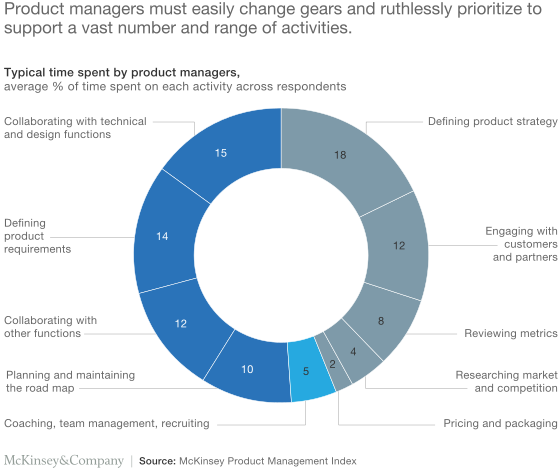
Almost 80% of product managers are involved in design efforts and go-to-market choices, with half of them also making essential pricing decisions, according to a report by McKinsey & Company.
60% of product managers have basic analytics abilities to dive into numbers and draw insights without relying on analysts.
2. How to become a product manager?
There are two ways to become a product manager – follow the conventional way by taking up a product management course or certification and then landing a job.
The other way could be doing courses and building skillsets related to product management by taking up such projects/tasks during work.
Check out our Introduction to Product Management Course from Great Learning Academy which gives you free access to 100+ courses to upskill yourself.
3. Is an engineering background necessary to be a product manager?
It is not mandatory to have an engineering degree or background to be a product manager. However, having an engineering background helps you, especially if you are looking for roles in software-related companies.
4. Which industry pays the best salaries for product managers?
Retail, Finance, Manufacturing, E-Commerce, Edu-tech, Travel, Healthcare and Software/IT are a few industries that pay decent salaries for product managers and have many roles related to product management.
5. Which companies generally hire product managers?
Few companies to name are:
- Amazon
- Flipkart
- Mckinsey and Company
- Paytm
- Airbnb
- Microsoft
- Uber
6. How is the future for Product Managers?
The future for Product Managers looks bright, and there has been a lot of career growth opportunities in Product Management over the last 4-5 years. There will be more growth in the upcoming years, considering the rapid technological innovations and advancement.
According to Glassdoor, Product Manager is the 3rd best job in the United States in 2021.
7. Where can I do masters in project management?
You can do the masters or a PG program online as well as offline from any reputed institution/organization.
We recommend you to check out our PG Program in Product Management and Analytics
8. What are some good courses in Product Management?
There are plenty of courses in product management available online. Here are few of the best ones:
[ad_2]
Source link

